
Trustfull Domain
Overview
Trustfull Domain evaluates internet domains in real time to assess trust and business risk. It analyzes website legitimacy, technical setup, company presence, and external reputation signals to identify real, operating businesses versus low-effort or short-lived domains, providing clear risk signals and reason codes without harming conversion.
Want to learn how to set it up? Visit the dedicated Trustfull Domain API Reference.
Below, each section explains:
- What we see in trusted domains
- What we see in risky domains
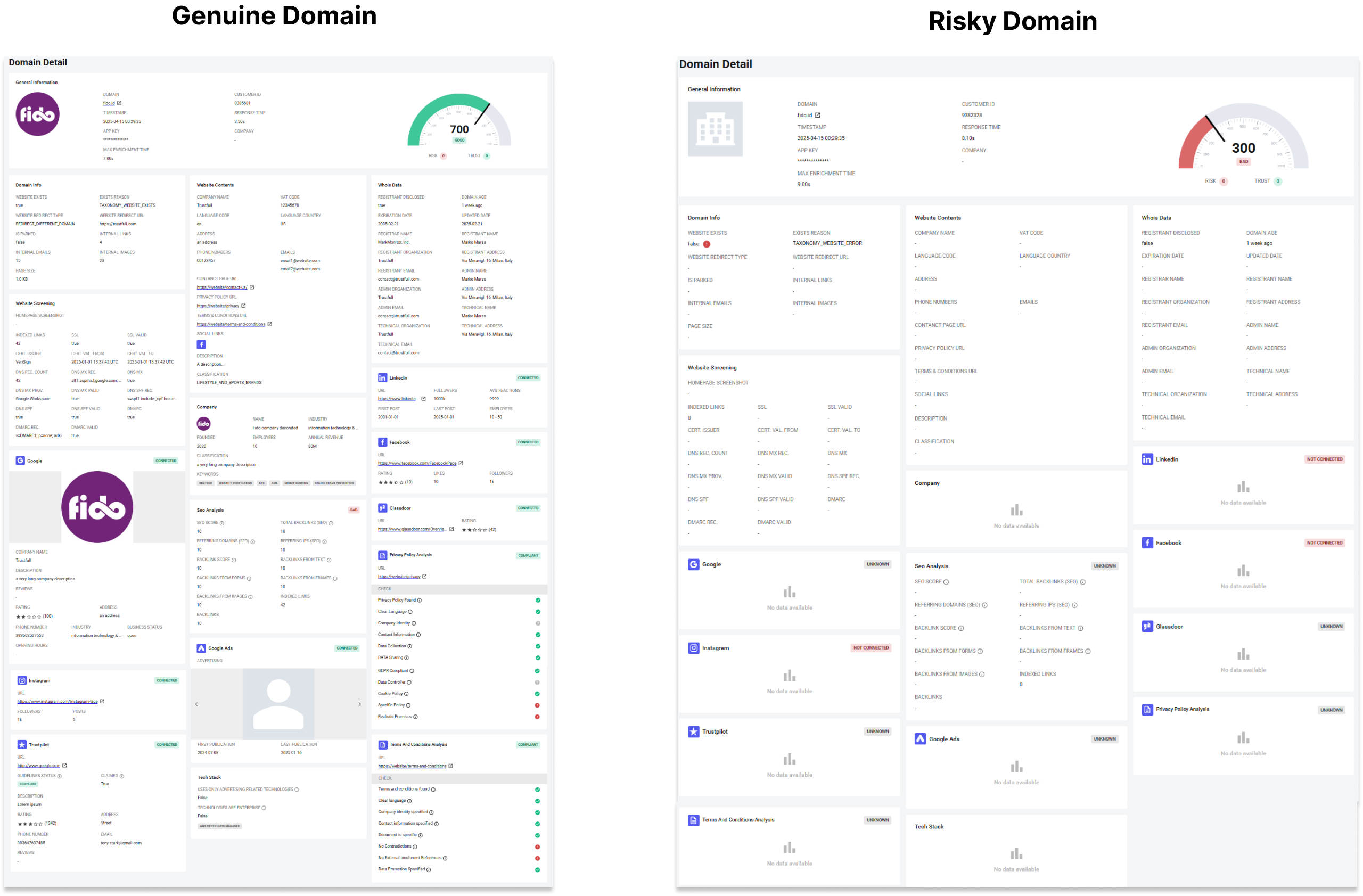
General Information
This section displays general information about the domain lookup:
- Timestamp: when the lookup was executed
- App Key: API key used to process the request
- Customer ID: proprietary identifier for the customer
- Max Enrichment Time: total number of seconds available for enrichment
- Response Time: time required to retrieve and return the data
This information is mainly used for auditing, monitoring performance, and troubleshooting enrichment workflows.
Score
Trusted Domain
- High score | Label:
GOOD / HIGH| Risk Signals:0–1| Trust Signals:4+
A high domain score indicates that website presence, company information, and technical signals reinforce each other, forming a coherent and credible online identity consistent with a legitimate business.
Risky Domain
- Low score | Label:
LOW / POOR| Risk Signals:3+| Trust Signals:0–1
Low scores typically emerge when domains lack real web presence, show weak technical credibility, or appear newly created and disconnected from any operating organization.
Reason Codes Examples
- Trust codes: Domain has website | Domain indexed | Domain Has Linkedin | Domain Age
- Risk codes: Domain without website | Domain Website Is Parked | Domain Website Page Size Too Small | Domain Age
Curious how the score is calculated? Explore our Reason Codes and the Scoring Methodology and that drives them.
Domain Info
Trusted Domain
- Website is present and reachable
- Domain is linked to an active, non-parked website
- Page size and structure indicate real content
Legitimate domains usually host actual content and assets, which accumulate naturally over time and are costly to fake or rotate frequently.
Risky Domain
- Website missing, parked, or redirect-only
- Extremely small or empty page content
- Placeholder or inactive website structure
Domains created for short-lived activity often exist only to support campaigns and are built with minimal effort.
Website Screening
Trusted Domain
- Homepage screenshot shows coherent branding
- Website content matches stated business purpose
- No obvious phishing or misleading layout
Visual inspection helps validate that the domain represents a real business rather than a generic or deceptive landing page.
Risky Domain
- Generic or misleading homepage appearance
- Inconsistent branding or unclear purpose
- Thin or templated content
Fraudulent domains are often rushed and prioritize deception or conversion over credibility and clarity.
Website Contents
Trusted Domain
- Company name and description present
- Contact details available
- Privacy policy and terms pages found
- Language and country signals consistent
Real businesses usually publish corporate and legal information as part of compliance and long-term trust building.
Risky Domain
- Missing or inconsistent business details
- No privacy policy or terms pages
- Generic or vague descriptions
Low-quality or fraudulent domains often omit this information because they are not designed to withstand scrutiny or disputes.
WHOIS Data
Trusted Domain
- Domain age indicates established history
- Registration timeline appears stable
- No unusual registrar patterns
Older domains with stable registration history are harder to abuse at scale and usually reflect long-term ownership.
Risky Domain
- Very recent domain creation
- Opaque or undisclosed registrant
- Registrar associated with low-trust domains
Fraud domains are often created quickly and rotated often, resulting in short and unstable registration histories.
Company
Trusted Domain
- Company entity identified
- Industry and keywords align with website content
- Company signals consistent across sources
When company metadata aligns with website activity, it strongly indicates a legitimate operating organization.
Risky Domain
- No associated company information
- Company signals vague or inconsistent
- Mismatch between claimed activity and website
Suspicious domains frequently fail consistency checks between what they claim and what is observable.
Social and Professional Presence
Trusted Domain
- Presence on professional or social platforms
- Profiles consistent with company identity
- Evidence of sustained activity
Real businesses tend to accumulate a public footprint over time, even if social activity is limited.
Risky Domain
- No social or professional profiles
- Recently created or inactive pages
- Branding inconsistencies across platforms
Short-lived or fraudulent domains may create superficial profiles that lack history and engagement.
Reviews and Reputation
Trusted Domain
- Reviews available on reputable platforms
- Review volume and content look organic
- Reputation signals align with business activity
Genuine customer feedback is difficult to fabricate convincingly and usually reflects real operations.
Risky Domain
- No reviews across major platforms
- Extremely limited or suspicious review footprint
Fraud domains rarely remain active long enough to accumulate credible reputation signals.
SEO & Discoverability
Trusted Domain
- Domain indexed by search engines
- Presence of backlinks or referring domains
- Signals consistent with an active website
Search visibility acts as a proxy for longevity and real-world relevance.
Risky Domain
- Few or no indexed pages
- Extremely weak backlink footprint
Disposable domains often disappear before building any meaningful organic presence.
Final Takeaway
A trusted domain:
- Has history
- Has real content
- Has external presence
- Represents a coherent business
A risky domain:
- Is new or disposable
- Has thin or missing content
- Lacks external validation
- Exists mainly to support short-lived activity
Trustfull Domain is designed to separate these two profiles in real time, enabling faster KYB, merchant due diligence, and fraud screening without penalizing legitimate businesses.
📚 Resources
- Support Center — Assistance and answers from the Trustfull team.
- Trustfull Domain API Reference page — Technical guidance on setup.
Updated 5 days ago